Showing posts with label Honda Accord. Show all posts

Friday, July 22, 2011

The 5th Generation Honda Accord

Honda-Accord-1994

Car Auto Online  | The 5th Generation Honda Accord | Japan, North America and Australia (wagon and coupe only for Europe). In 1994, the Honda Accord was moved to yet a larger "CD" chassis, primarily to better suit the requirements of the North American market. It grew in width but oddly shrunk in length, leaving it classified as a mid-size car in North America. It thus became too wide to fit within the favorable tax bracket in Japan, where its role was to be partially taken over by the smaller second-generation Honda Ascot and Honda Rafaga. The engines offered also exceeded the maximum limit of 2000 cc to remain in the favorable tax bracket as well. Honda of Japan marketed four different size engines in the Japan-Spec Honda Accord Sedan:1.8, 2.0, 2.2 VTEC and 2.2 DOHC VTEC. The Japanese-spec Accord models were marketed as the following: EF, EX, 2.0EX, 2.0EXL, 2.2VTE, 2.2VTL, 2.2VTS and SiR.

Honda-Accord-1994

DX, LX and EX remained the American trim lines while Canada retained the LX, EX and EX-R. The 5-speed manual transmission remained mostly unchanged, while the 4-speed automatic noted for its hard shifts, now included Honda's "Grade-Logic" shift program. All Accord models received a more ergonomic interior with standard safety features such as dual airbags and reinforced side-impact beams. Exclusive to the EX was the F22B1 SOHC VTEC version of previous generation 2.2-liter 4-cylinder (making 145 hp (108 kW) up from 140 hp (104 kW) on the previous generation EX), anti-lock brakes (now an option for the LX), 4-wheel disc brakes, 15" alloy wheels, and a rear stabilizer bar. Leather was an option in the EX trim with leather equipped models now being referred to as EX-L. DX and LX models came equipped similarly to the previous generation and were fitted with a revised version of the previous generation's 2.2 liter non-VTEC 4-cylinder engine. This F22B2 engine was rated at 130 hp (97 kW) up from 125 hp (93 kW) the previous generation. The Accord was again named Motor Trend Import Car of the Year for 1994. The Accord coupe as in the previous generation looked almost exactly like the sedan, and was the last generation of the Accord to offer a wagon variant in North America until the introduction of the Accord Crosstour in 2009.

Honda-Accord-1995

Honda of Japan produced three high performance models of the Accord (sedans, coupes, and 96–97 wagons) for the Japanese market (JDM) referred to as the SiR model which was available for sale in Honda CLIO dealerships in Japan. The Honda Accord SiR models were not hard to tell apart from the Accord EX model; which came equipped with the Japan-spec H22A DOHC VTEC engine instead of F22B1 SOHC VTEC engine. The Japan-spec H22A DOHC VTEC engine specs were 190 bhp (142 kW; 193 PS) at 6800 rpm; peak torque 152 lb·ft (206 N·m) at 5500 rpm with a compression ratio of 10.6:1. The Japan-spec H22A DOHC VTEC engine was similar to the H22A1 engine found in the North America market used in the Prelude DOHC VTEC of the same era. The Japan-built Accord SiR Sedans (94–97) came available with a 5-speed manual transmission as standard equipment or an optional four-speed automatic transmission. The Honda of America-built (HAM) Accord SiR Coupes and then the 96–97 Accord SiR Wagons had the four-speed automatic transmission as standard equipment (5-speed manual transmission were not available for these two models). It came with cloth sport seats styled similar to the Prelude and had some power options found on the Accord EX. The Accord SiR Coupes (94–97) and the Accord SiR Wagons (96–97) were exclusively available for the Japanese market (JDM). Honda Accord SiR chassis codes for the sedan were the CD6, the coupe-CD8 and the 96–97 wagon-CF2. The Accord SiR Coupes and the Accord SiR wagons (96-97) which were exclusively built in the U.S. at Honda's Marysville Ohio plant (HAM) but were marketed for Japan export only for this particular model was not offered in North America. The Accord SiR Coupes and then the Accord SiR Wagons were built with the Japan-spec H22A DOHC VTEC powertrains which were shipped from Japan and were installed into the HAM-built Accord SiR models. The 1994–1997 "CD" Accord chassis was designed for the H22A DOHC VTEC powertrain to be installed; because the firewall was curved at the top to allow more space for the tilting backwards of the H22A DOHC VTEC engine near the middle of the firewall. The H22A DOHC VTEC engine was the most powerful inline four cylinder engine Honda built for the Prelude and the Accord before the 1995 U.S.-spec V6 sedan. The Accord SiR suspenion was improved with stiffer front swap bar(27.2mmXt4.0mm), stiffer rear swap bar (16 mm), stiffer front coil springs and stiffer rear coil springs. Features for the 94–95 Accord SiR models (sedans and coupes) included the following items: cruise control, automatic climate control (Similar to the first generation Acura CL), Bose stereo system, 7,400 redline tachometer, optional electronic traction control and optional limited slip differential for automatic transmission, optional SRS and airbags, factory installed driving lights, optional factory installed "pop up" navigation radio head unit, sound insulation liner under front hood, black housing front headlights, no side molding was available on the Accord SiR sedan, optional sunroof and power retractable outside mirrors. Features for the 96–97 Accord SiR models (sedans, coupes and wagons) included the same as above while adding; optional cruise control, rear window wiper on the sedan, optional leather interior and a colored side molding for the sedan as well.

Honda-Accord-1995

In 1995, the Accord debuted a V6 engine, the 2.7L C27 borrowed from the first generation Acura Legend, in the U.S. market. The V6 was offered in both the LX and EX versions of the sedan, LX models being referred to as LX-V6 and EX models as EX-V6. EX-V6 models came equipped similarly to the EX-L with leather seats being the only option in the EX-V6. Addition of the taller C27 engine required substantial alterations to the CD platform, with V6 models sporting a redesigned engine layout, taller front fenders, and a different hood than I4 models; however, these differences are difficult to spot without both models parked side-by-side. Both versions of the V6 received a dual-outlet exhaust, a 4-speed automatic transmission, 15" machined aluminum alloy wheels on the EX-V6 and 15" steel wheels with full covers on the LX-V6, and a slightly updated front grille. The Accord saw very few other changes in 1995 with the exception of a few different exterior and interior color combinations.

Honda-Accord-1996

In 1996, Honda Accord underwent the usual mid-generation facelift. More rounded bumpers, a slightly modified front fascia with new signal lights and rear taillights gave the Accord a softer look. All Hondas now complied with the federal government's requirement of OBD II engine diagnostics though all three engine choices remained the same. In order to increase the Accord's competitiveness against its rivals in different international markets, Honda CEO Nobuhiko Kawamoto decided on one basic platform for the sixth-generation Accord, but with different bodies and proportions for local markets. In the U.S. the 1996 model lineup included the 25th Anniversary Edition, a model positioned between the DX and LX.

Honda-Accord-1996

In 1997, Honda released the "Special Edition" version of the Accord (not to be confused with the SE). It was offered in three colors: Heather Mist Metallic, San Marino Red and Dark Currant Pearl. The Special Edition received a factory installed security system with keyless entry, single-disc CD player, body colored side molding, distinctive alloy wheels and a sunroof. It was offered in an automatic transmission only and was fitted with the same engine as the LX.

Honda-Accord-1997

In New Zealand, the 5th generation Honda Accord was assembled at Honda's manufacturing site in Nelson and was released in March, 1994. It was available in LXi, EXi and EXi-S trim levels. A facelift was released in December 1995, which coincided with the release of VTEC engines in the upper-spec models. Trim levels were LXi, VTi, and VTi-S. These were the first NZ-market Accords to have airbags – two in the VTi-S, one in the VTi. - Car Review

The 5th Generation Honda Accord

Tags: used honda accord dallas, honda accord warranty, used honda accord chicago, used honda accord houston, 2009 honda accord tires, 2004 honda accord tires, honda accord transmission problems, tires for honda accord 2008, tires for 2006 honda accord, tires for honda accord 2007
Monday, June 6, 2011

limited distribution and guaranteed fun! - 2011 coupé HFP, canada honda accord

canada honda accord

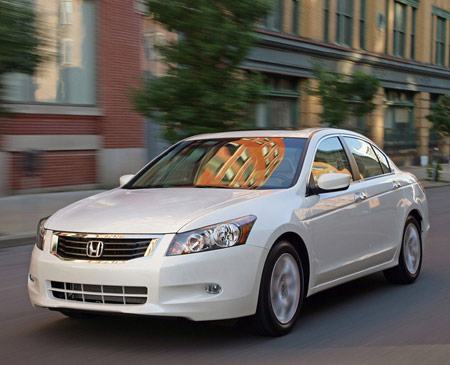
Car Auto Online | limited distribution and guaranteed fun! - 2011 coupé HFP, canada honda accord: I must admit I'm not really fond of the Honda Accord of this generation. Indeed, although its engines and transmissions are remarkable, this version leaves me on my appetite. It was swollen, and elongate the spark that made it fun to drive Accord has virtually disappeared. Moreover, if the silhouette of the coupe is correct, that of the sedan is flawed. At least that's my opinion. But as you know, tastes and colors can not be discussed.

By cons, although many have criticized the quality of the materials of the most economical versions, the Accord continues to offer a good assembly quality and reliability is above average.

Last week I had the opportunity to conduct a special version of the coupe, the HFP. This is the first time that Honda sells a version of Honda Factory Performance HFP. Having resisted the tendency of manufacturers to modify one or more models with accessories bearing a particular label, Honda has followed suit. At Toyota, we know the TRD accessories for Toyota Racing Department and of course there are models Mazdaspeed Mazda to name them. Thus, using accessories provided by the manufacturer and therefore approved by it, the car can be modified and customized, while its performance and handling are improved.

200 editions only!
In our case, this is a limited edition version with only 200 copies will be available in Canada. Anyway, among the most important changes, it must be stressed that the suspension has been lowered, which the dampers are more efficient while the wheels of 19 inch alloy are furnished with exclusive Michelin MXM4.

Of course, it must produce its difference to the world! For this purpose, special front and rear spoilers identify this Agreement a little strange. When we see this model for the first time, it is the gray titanium alloy wheels which we are obvious. Not only is the 10-spoke design is successful, but the original color brings a unique twist. Thanks to the lower suspension, the front baffle which almost touching the tarmac and the mini spoiler on the trunk, the car has the poise on the road.

Inside, there is not much more than the normal version, however, I think we could have done better. Our model was equipped with leather seats and a shifter knob also lined with leather. For the rest, it's almost the same as the less-exclusive. It has even resisted the temptation to use an aluminum pedals. In passing the foot of very large dimension that adds to driving pleasure.

Driving pleasure
Often, modified cars disappoint us: it was so focused on presenting the benefits, though improved, we leave on our appetite. This is not the case with this car and I really enjoyed the ride. First and foremost, and this is not a discovery, the 3.5-liter V6 engine is really excellent. He loves high speeds, it is soft, quiet and the power curve is well distributed. In addition, when not in charge, an electronic system shuts down half the cylinders to save fuel. Our test version was equipped with a manual six-speed. As in most cases at Honda, the guidance of the shifter is precise and consistent with a clutch pedal which the race is virtually flawless.

Of course, not everything is perfect. We must first mention that the ergonomics of the Agreement is still frowning. The button controls are generally fairly well distributed, but difficult to identify. We need eyes off the road for several seconds if you want to tune the radio or air conditioning. For cons, the car navigation system is efficient and easy to use. As for the rear seats, as on every cut, and it means they are reserved for small people.

A sports Agreement
Probably due to a lowering of the suspension and the center of gravity, the car is more neutral cornering. Another factor explaining this behavior is probably the front wheel camber changes due to the use of different tires. The car is also more stable cornering and steering is more precise. Fun to link turns and play shifter. I doubt that the life of these tires sport will be short and that their replacement would be expensive, but if you're among people who enjoy driving pleasure, is the price you pay.

Curiously, the more agreement is progressing in its development, the more it is aimed at relatively small niche market. Some will talk about a change of vocation, but I think it wiser to talk about complementary products from diversifying the supply base is still targeting the general public. And it is normal that over the years, more specialized versions are added.

Whatever the reasons, the Accord Coupe HFP is very interesting and its great fault is that its availability will be limited to 200 copies.

Tags: honda accord warranty, used honda accord chicago, used honda accord dallas, honda accord transmission problems, 2008 honda accord mpg, honda accord tires, tires honda accord, tires for a honda accord, tyres for honda accord

Wednesday, May 25, 2011

ConsumerReports.org® Overview: 2011 Honda Accord Sedan LX-P 4-cyl

2011-Honda-Accord-Sedan-LX-P-4-cyl
Car Auto Online | ConsumerReports.org® Overview: 2011 Honda Accord Sedan LX-P 4-cyl - Honda Accord remains a family sedan well balanced, but falls behind some new competition and better. Highlights include spacious rooms and rear, excellent driving position, visibility great driver, and most simple controls. The standard powerplant, a 177-hp, 2.4-liter 4-cylinder transmission and five-speed automatic is smooth and refined, but not super fast. There will be 25 mpg in 2011. A 271-hp V6 reagent and a manual transmission is available tide. tire traction and braking performance is slightly decreased. maneuverability and flexibility, controlled ride remain, as do some major road noise.

ConsumerReports.org® Overview:
Highs: Fuel economy, steering, ride, rear seat room, driving position, visibility, controls, crash-test results
Lows: Road noise, sparse amenities

Related Posts:

Consumer Reviews: 2011 Honda Accord

honda-accord-2011
Consumer Reviews: 2011 Honda Accord | Car Auto Online - For 2011, the Honda Accord continues to go about their business of providing safe transportation to turn your player into an interesting and enjoyable. There's really nothing to objective criticism about specifications and features of the agreement, all runs with precision. But the result is so sterile and clinical, as it is almost frustrating to drive. There are a couple of bright spots, however. First, the fantastic 3.5-liter V6 271-power motor that spins rapidly and threatens to add a spark in the Agreement. And the no-nonsense interior is attractive. Anyway, it's not spectacular enough to overcome the boredom that shadows the rest of the package. - Mike Meredith

I always thought that the Honda Accord as rather boring, basic transportation. But I must say, the 2011 is somewhat different. It is exciting to watch, especially on the grid wide. But the interior is well done - in the case of our test model, leather and wood - and has a large rear seat and plenty of trunk space. And it makes much better than I expected. With powerful engine under the hood of the V6, acceleration is strong and the handling is decent - more than enough for the needs of most buyers. With a tag of $ 32K for a fully loaded model, the Accord is a good option as a comprehensive family sedan. - Perry Stern

I thought the Honda Accord is the perfect car: efficient, fast, smooth, well made and pretty. And while the interior has never been so luxurious, it never felt chintzy. But I grew up, and now I know that make you happy for many years of ownership, cars can be not only effective but also needs some character. The new Honda Accord has absolutely no character. Is smooth with almost any other car is at least a little more palatable or inspired. The Agreement is boring, and I would soon tire of it, or at least begin to ignore their good points. I'm sure Honda can do better, considering that the overall experience rather than focusing solely on engineering.  - Paul Hagger

Tags: used honda accord denver, used honda accord phoenix, honda accord extended warranty, honda accord warranty, used honda accord dallas, honda accord transmission repair, used honda accord chicago, used honda accord houston, honda accord dallas

Friday, April 15, 2011

The 4th Generation Honda Accord

Honda Accord 1990

Car Auto Online | The 4th Generation Honda Accord | The 4th Generation Honda Accord was launched in Japan in 1990 as a based on the "CB" chassis Accord. The 4th Generation Honda Accord was the first not to feature a three-door model, and the first one to be exclusively sold by the Honda Clio dealer network in Japan. A sister car, called the Honda Ascot, differing only slightly from the JDM Accord sedan, was launched for sale in Honda Primo stores that also carried previous-generation Accords. On the other hand, the Honda Vigor, previously closely related to the Accord, became a rather different model, fitted with a longitudinally-mounted inline five-cylinder engine.

Honda Accord Sedan 1990
The 4th Generation is more conservative Accord and now bore a stronger resemblance to its upscale sibling the second-generation Acura Legend. The Accord had matured into a larger car, now approaching the likes of the midsize Ford Taurus, gaining midsize status.

The 4th Generation Honda Accord was one of the first U.S. production cars to feature optic reflectors with completely clear lenses on the headlamps replacing the more conventional lens diffused lighting. Unlike most manufacturers moving away from traditional sealed beam lighting, Honda chose to transition to a multi-reflector headlight style while maintaining the use of a glass lens instead of plastic.

For this 4th generation Accord, Honda made significant engineering design improvements. All Accords sold in North America came with a completely new all aluminium 2.2 liter 16-valve electronic fuel injected engine standard, replacing the previous 2.0 liter 12-valve model from the past generation. Also noteworthy, all Accords equipped with automatic transmissions used an electronically controlled rear engine mount to reduce low frequency noise and vibration. The mount contained 2 fluid filled chambers separated by a computer controlled valve. At low engine speeds, fluid is routed through the valve damping vibration. Above 850 rpm, fluid is routed around the valve making the engine mount stiffer.

Honda Accord 1991
In the U.S., the LX-i and SE-i designations were dropped, being replaced with the DX, LX, and EX trim levels. The Canadian Accord trim levels varied slightly from the U.S. models with LX, EX and EX-R roughly corresponding to the American DX, LX, and EX, respectively. Fourth generation Japanese-assembled EXi Accords sold in Australia offered the same 4-wheel steering technology as was available optionally on the U.S. Honda Prelude, but was not included on the New Zealand-assembled versions. U.S. Accord Coupes were available in the same DX, LX and EX trims as the U.S. Accord Sedan (LX, EX and EX-R in Canada).

Honda Accord 1992
A 125 horsepower (93 kW) 4-cylinder engine was offered in the DX and LX models (F22A1), while the 1990 and 1991 EX received a 130 hp (97 kW) version (F22A4). Cruise control was dropped from the DX sedan, with air conditioning remaining a dealer-installed option. The LX kept the same features as the previous generation including air conditioning, power windows, door locks, and mirrors. The 90-91 EX added 5 horsepower due to a different exhaust manifold design, slightly larger exhaust piping and a twin outlet muffler. 15 inch machined aluminum-alloy wheels, sunroof, upgraded upholstery, rear stabilizer bar and a high-power 4-speaker stereo cassette were standard on all EX models. Some models though rare were special ordered with an anti-lock braking system (at that time abbreviated as ALB, now all automakers refer to it as ABS). A redesigned manual transmission with a hydraulic clutch was standard equipment in all trims while an all-new electronically controlled 4-speed automatic transmission was optional for all models.

Some new dealer-installed accessories were now offered including a single-disc in-dash CD player or trunk mounted 6-disc CD changer, stereo equalizer, fog lights, security system, rear wing spoiler, trunk lip spoiler, luggage rack, full and half nose mask, center armrest, window visors, sunroof visor, car cover, and a cockpit cover.

Honda Accord 1993
Because of tightening auto safety regulations from the NHTSA, all 1990 and 1991 Accords sold in the United States came equipped with motorized shoulder belts for front passengers to comply with passive restraint mandates. These semi-automatic restraints were a two component system; a motorized shoulder belt along with a non-integrated and manually operated seatbelt. The shoulder belts automatically raced around each window frame encircling both the driver and front seat passenger whenever the front door closed. The process reversed to release them when opened. The lap belts however, still required manual fastening.

In 1991 Honda unveiled the Accord Wagon, manufactured at the Marysville, Ohio plant. The Ohio plant exported right-hand drive wagons and coupes to Europe and Japan. European and Japanese vehicles had options not available within the U.S. including automatic climate control systems, power seats and several other minor features. The Accord Wagons were available only in LX and EX trim in North America or just 2.2i in Japan. They had larger front brakes to compensate for the added weight and unlike other U.S. Accords, included a driver's side airbag as standard equipment. Other than a retractable tonneau cover in the rear cargo area and keyless entry on EX models, the wagons were equipped the same as their coupe and sedan counterparts.

Related Posts:

Monday, April 11, 2011

The 3rd Generation Honda Accord

Honda Accord 1986

Car Auto Online | The 3rd Generation Honda Accord | The 3rd generation Accord was released in Japan in 1985 and in Europe and North America in 1986. The third generation Honda Accord had a very striking exterior design, bearing a resemblance to the second and 3rd generation Honda Prelude. One notable feature was the flip-up headlights, due to the new premium level Honda Legend having a more conservative appearing fixed, aerodynamic flush halogen headlights. Sedan models sold on the European market featured fixed headlights and a different taillight cluster design.

Honda Accord 1987
Honda Accord 1987
The 3rd generation Accord became the first Honda to employ double-wishbones at both the front and rear ends—a layout that spread to the Legend, Civic and Prelude in 1988 and the Integra in 1990. While more expensive than competitors' MacPherson strut systems, this setup provided better stability and sharper handling for the vehicle. All had front sway bars and upper models had rear sway bars as well. Brakes were either small 4-wheel discs with twin-piston calipers (only available on the JDM 2.0-Si model ), larger 4-wheel discs with single piston calipers, or a front disc/rear drum system. ABS was available as an option on the 4-wheel disc brake models, though not in North America. Base model Accords rode on 13-inch steel wheels with hubcaps with more expensive models having the option of 14-inch alloy wheels.

The 3rd generation Honda Accord's available engines varied depending on its market: Japan received the A18A, B18A, and B20A; Europe received the A16A1, A20A2, A20A4, B20A2 and B20A8, and North America received the A20A1 and A20A3.

Honda-Accord-1986
Honda Accord 1988
The 3rd generation Honda Accord's trim levels ranged from spartan to luxurious. In the Japanese home market, the Accord was available with a full power package, heated mirrors (optional), a digital instrument cluster (optional), sun roof (optional), cruise control, and climate control (which was also optional). Some North European export models also had heated front seats and head light washers. North American and Australian Accords were not available with most of these options, presumably (and in the U.S. in particular) because Honda was seen as a builder of economy cars, and not to cannibalize sales from the recently introduced Acura line.

Honda-Accord-coupe-lx-1989
Honda Accord Coupe LX 1989
The 3rd Generation Honda Accord was available in a range of different body styles, including a 4-door sedan, 4-door sedan with fixed head lights for the European market, a 3-door hatchback, and a 3-door "Aerodeck" which resembled the third generation Civic hatchback subcompact; but was not sold in U.S. or Canada. A 2-door coupe was added for the 1988 model year, built exclusively in Honda's Marysville, Ohio factory. The vehicles were exported back to Japanese market, where it was known as the US-Coupe CA6.

Tags: honda accord tires, 2008 honda accord mpg, honda accord transmission problems, honda accord dallas, honda accord transmission repair, honda accord warranty, honda accord extended warranty

Thursday, April 7, 2011

Second Generation Honda Accord

Honda Accord 1985
Honda Accord 1985
Car Auto Online | Second Generation Honda Accord | Second Generation Honda Accord was debuting on September 22, 1981 in Japan and Europe. And as a 1982 model in North America, Second Generation Honda Accord which was being produced in Japan, became the first to also be built in the U.S., at Honda's plant in Marysville, Ohio. Since its first year in the American market, it also became the best-selling Japanese nameplate in the U.S., holding that position for about 15 years. In Japan, a sister model called the Honda Vigor was launched simultaneously with the new Accord.

Modernizing both the interior and exterior, the second generation Accord was mechanically very similar to the original, using the same 75 hp (56 kW), 1,751 cc (1.751 L; 106.9 cu in) EK1 CVCC engine. Fuel economy increased by nearly 15%. Vastly improved quality control however, made this one of the most reliable cars on the U.S. market, a position it still holds today. This automobile included popular features of the time such as shag carpet, velour cabin trim and chrome accents. An optional extra on the 1981 Accord was an Electro Gyrocator, the world's first automatic in-car navigation system. Models were available in Silver, Sky Blue, and Beige. The LX hatchback offered a digital clock and slightly higher fuel economy (due to its lighter weight).

Honda Accord 1982
Honda Accord 1982
The National Highway Traffic Safety Administration imposed stringent lighting requirements on U.S. models which prevented Honda from including the aerodynamic molded headlight units which were used on Accords sold outside North America. The U.S. NHTSA required the use of sealed beam glass units to prevent fogging and allow for easy and readily available replacement of units damaged by rocks or other road hazards. U.S. Accords were also required to have a side marker light installed on the side of the rear fenders. European Accords included additional rear fog lights embedded into the rear bumper (mandatory there since 1980), as well as headlamp spray washers.

Honda Accord 1983
Honda Accord 1983
When Honda New Zealand won a government order for black-and-white traffic patrol cars, it included the European rear bumpers in the assembly kits and rewired fog lamps for additional rear red flashing warning lamps as part of the special police-pack equipment. Japanese Accords were unique from all other markets in that they included adjustable ride height control and side view mirrors installed on the mid-forward fenders.

Honda Accord 1984
Honda Accord 1984
In 1983, Honda upgraded the automatic transmission to a four speed, a major improvement over the earlier, three speed 'Hondamatic' transmission. The manual five speed transmission remained unchanged. A new 120 mph (190 km/h) speedometer replaced the earlier 85 mph (137 km/h) unit. The Special Edition (SE) featured novio-leather seating, power windows, power sunroof and door locks. Gray was added as a color option.

Wednesday, April 6, 2011

First Generation Honda Accord

Honda-Accord-Hatchback-1976

Car Auto Online | First Generation Honda Accord | Honda chose the name Accord, reflecting "Honda's desire for accord and harmony between people, society and the automobile." The initial design was changed to a fuel efficient, low emission vehicle since it was introduced during the fuel crises of the 1970s. In the United States and Japan, a version was produced using Honda's CVCC technology, meeting emission standards of the 1970s and early 1980s without a catalytic converter.

Honda-Accord-Hatchback-1977
Honda Accord Hatchback 1977

The first generation Honda Accord was launched on May 7, 1976 as a three-door hatchback with 68 hp (51 kW), a 93.7-inch (2,380.0 mm) wheelbase, and a weight of about 2,000 pounds. It was larger than the tiny Honda Civic at 162 inches (4,115 mm) long. The Accord sold well due to its moderate size and great fuel economy. It was the first Japanese small car with features like cloth seats, a tachometer, intermittent wipers, and an AM/FM radio as standard equipment. 

Honda-Accord-Hatchback-1978
Honda Accord Hatchback 1978

In 1978 an LX version of the coupe was added which came with air conditioning, a digital clock, and power steering. 

In 1979 a four-door sedan was added to the lineup, and power went to 72 hp (54 kW) when the 1,599 cc (97.6 cu in) An EL1 engine was supplemented and in certain markets replaced by the 1,751 cc (106.9 cu in) an EK-1 unit.

Honda-Accord-Hatchback-1979
Honda Accord Hatchback 1979

In 1980 the optional two-speed semi-automatic transmission of previous years became a three-speed gearbox (a 'proper' self-shifting four-speed automatic transmission was not used in the Accord until the 1984 model year). Slightly redesigned bumper trim, new grilles and taillamps and remote mirrors were added on the 4-door (chrome) and the LX (black plastic) models. The CVCC badges were deleted. 

Honda-Accord-Hatchback-1980
Honda Accord Hatchback 1980

In 1981 an SE model was added for the first time, with novio-leather seats and power windows. Base model hatchbacks, along with the 4-door, LX, and SE 4-door, all received the same smaller black plastic remote mirror. The instrument cluster was revised with mostly pictograms which replaced worded warning lights and gauge markings. Nivorno Beige (code #Y-39) replaced Oslo Beige (#YR-43). Dark brown was discontinued, as was the bronze metallic. The shifter was redesigned to have a stronger spring to prevent unintentional engagement of reverse, replacing the spring-loaded shift knob of the 1976 through 1980 model cars.

Honda-Accord-Hatchback-1981
Honda Accord Hatchback 1981

Tags: honda accord extended warranty, used honda accord phoenix, used honda accord denver, honda accord warranty, used honda accord dallas, honda accord transmission repair, used honda accord chicago, used honda accord houston, honda accord dallas, honda accord chicago, honda accord transmission problems

Thursday, March 17, 2011

About Honda Accord

Honda Accord

Car Auto Online | About Honda Accord | Honda Accord has achieved considerable success, especially in the United States, where it was the best-selling Japanese car for fifteen years (1982–97), topping its class in sales in 1991 and 2001, with around ten million vehicles sold. Numerous road tests, past and present, rate the Accord as one of the world's most reliable vehicles.

Honda Accord
Honda Accord 1996

Since its debut, Honda has offered several different car body styles and versions of the Accord, and often vehicles marketed under the Accord nameplate concurrently in different regions differ quite substantially. It debuted in 1976 as a compact hatchback, though this style only lasted through 1981, as the line-up was expanded to include a sedan, coupé, and wagon.

Honda Accord
Honda Accord First Generation (1976)

By the Accord's sixth generation in the 1990s, it evolved into an intermediate vehicle, with one basic platform but with different bodies and proportions to increase its competitiveness against its rivals in different international markets. For the current generation of the Accord released for the North American market in 2008, Honda has again chosen to move the model further up-scale and increase its size. This pushed the Accord sedan from the upper limit of what the U.S. Environmental Protection Agency (EPA) defines as a mid-size car to just above the lower limit of a full-size car, with the coupe still rated as a mid-size car.

Tags: honda accord extended warranty, used honda accord phoenix, used honda accord denver, honda accord warranty, used honda accord dallas, honda accord transmission repair, honda accord dallas, honda accord chicago, honda accord transmission problems